


Agentic Automation & Governance
At NC1, we implement agentic systems that classify, decide, and act on operational work under formal oversight.
The service is structured for enterprise operations that require independent verification, escalation thresholds, and a complete audit trail from intake through final disposition.
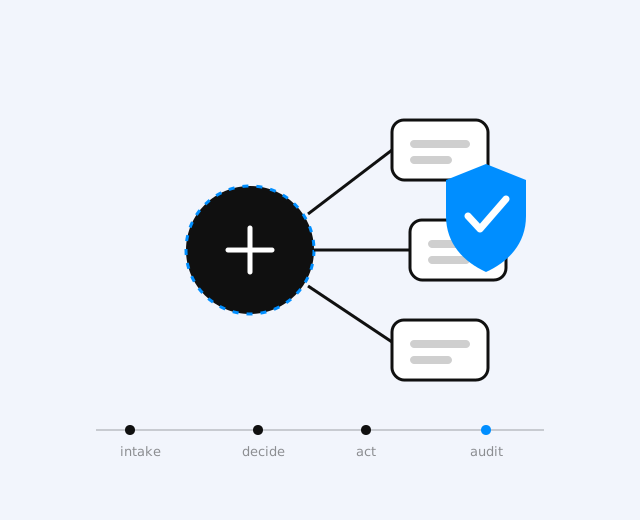
The service is structured for enterprise operations that require independent verification, escalation thresholds, and a complete audit trail from intake through final disposition.

Mandate
The mandate is not only to automate operational handling, but also to preserve accountable control across decisions, escalations, approvals, and records that must remain reviewable.
Governance
Control model
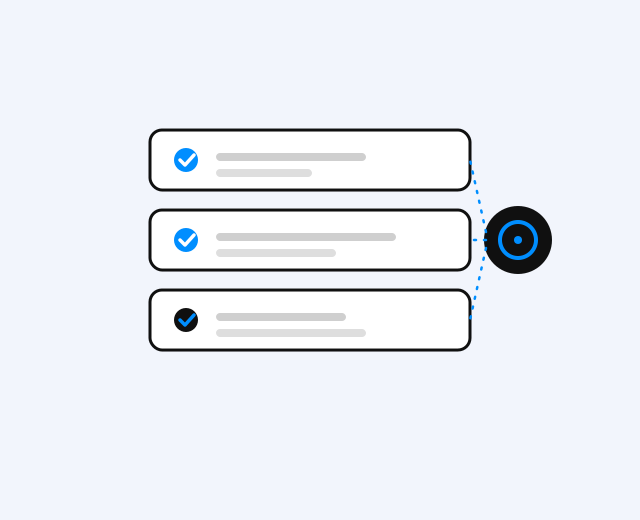
Agentic operations are framed with decision thresholds, independent checks, escalation paths, and retained evidence. This lets accountable teams supervise outcomes without manually handling every case.
Control stack
Operating offer
NC1 structures end-to-end automation for operational work that can be classified, decided, and acted upon under explicit business rules. The emphasis is on controlled execution, documented exceptions, and accountable supervision.
The service is appropriate where work volumes are material, decisions require consistency, and governance teams need a clear record of what the system handled, what it escalated, and what was approved by people.
Functions and controls
Work classification
Incoming operational items are assigned to defined categories, with ownership, priority, and required controls visible before action is taken.
Decision thresholds
Rules define which matters can proceed automatically, which require review, and which must be escalated to accountable staff.
Action execution
Approved steps are performed in the operating process, with status, exception reason, and disposition recorded for each item.
Independent verification
A separate verification pass checks classification, decision outcome, evidence, and escalation status before closure.





Governance by NC1

01.
Independent verification
Agentic outcomes are checked outside the initial action path. This separates execution from verification and gives supervisors a defensible basis for closure.
02.
Escalation thresholds
Every process receives defined stop points for uncertainty, value, policy, and exception conditions. The system does not decide beyond the approved operating mandate.
03.
Complete audit trail
Classifications, decisions, approvals, escalations, and residual exceptions are retained in a record that can be reviewed by operations, risk, and compliance teams.
04.
Human authority
Automation is bounded by accountable staff authority. People retain control over approvals, sensitive cases, and policy changes that require institutional judgment.
05.
Controlled change
Rule sets, routing, thresholds, and operating scope are reviewed before change. This keeps the agentic system aligned with current governance obligations.
06.
Operational accountability
The objective is not unsupervised autonomy. The objective is reliable operational handling with clear ownership, evidence, escalation, and management review.

